By Beth Allison Barr
Brazos Press: 2025.
Hardback, 232 pages
Reviewed by Anne Linstatter
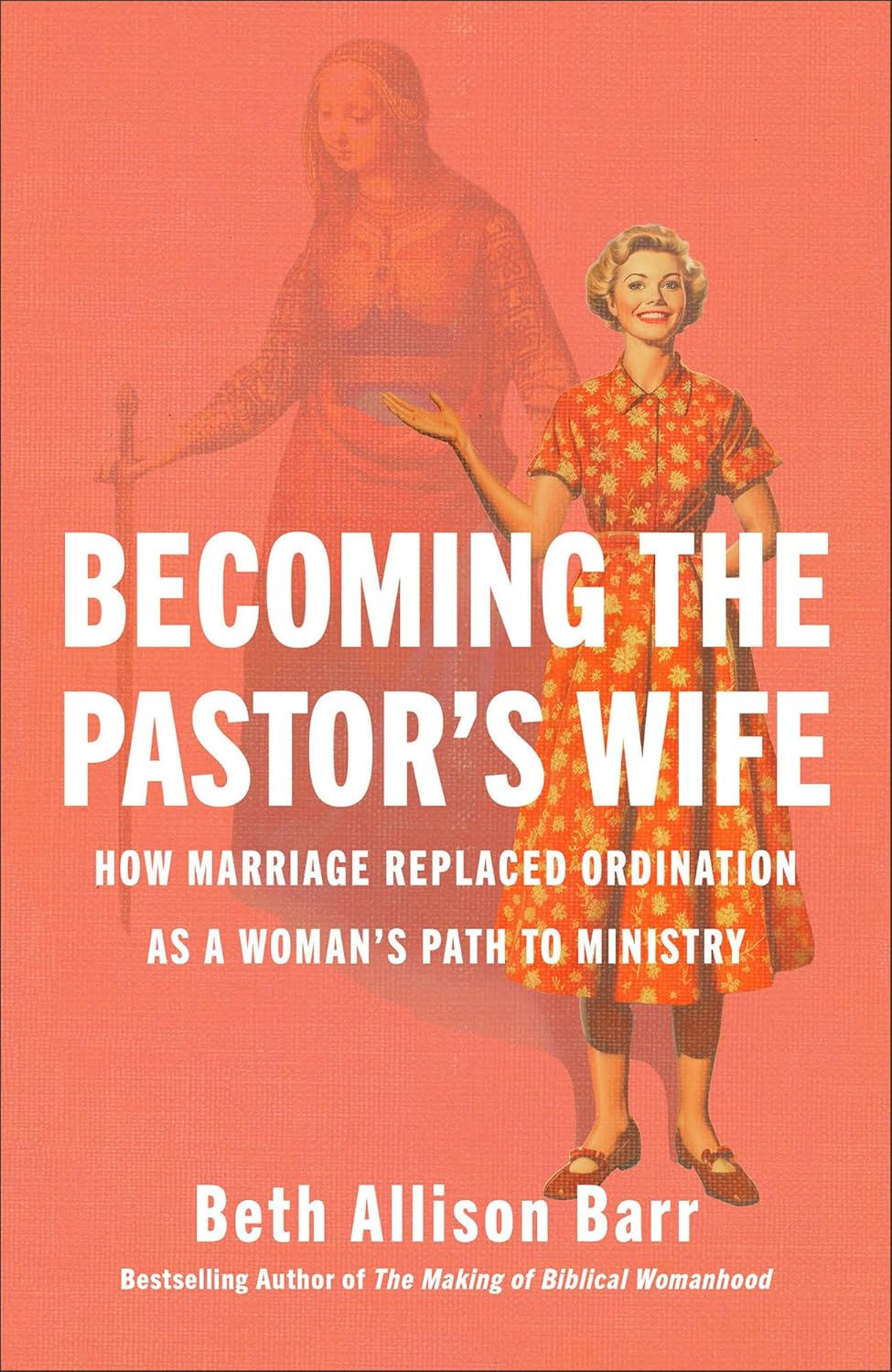 You can expect to be jolted from laughter to tears to anger in every chapter of this book.
Beth Allison Barr has written a manifesto against male domination in institutional churches through her second book for a popular audience: Becoming the Pastor’s Wife: How Marriage Replaced Ordination as a Woman’s Path to Ministry. In the first week after its release, her book made the New York Times Best Seller list in hardcover nonfiction.
In her first book, she alternated between her personal story and an astonishing overview of church history as it relates to women. She uses this technique again in Becoming the Pastor’s Wife, opening with a scene in which a woman (whose pastor husband has just retired) tells her, “Our new preacher is good, but he isn’t married. I’ll do the bulletin until he gets a wife.” Barr, herself the wife of a pastor, kept a straight face but was shocked to think that this unknown, possible wife “already had a job.”
In the first three chapters of her book, Barr looks at 1) pastors’ wives in the New Testament (missing—not required to help the disciples), 2) women priests and leaders in the next three centuries, and 3) powerful ordained women in the medieval church.
In the fourth chapter, she explains that the role of pastor’s wife is invented during the Reformation, and as a result, women both gain and lose power.
As a professor of history at Baylor University in Texas, Barr teaches courses in medieval history and women & religion in the 5th through 17th centuries. She has published scholarly books, but in this book she shows us her own reactions as she discovers a medieval woman depicted with a bishop’s staff or finds herself asked about her commitment to co-ministry while her husband is interviewed for pastor’s jobs. “Two for the Price of One” is the title of her fifth chapter.
Barr focuses on women in US Protestant churches in the last four chapters, particularly women in the Southern Baptist Convention, the largest evangelical church in the US. She grew up in the SBC, and her husband pastors a church affiliated with the Baptist General Convention of Texas.
Like other large denominations in the US, the SBC saw a jump in ordinations of women in the 1970s, but unlike the others, it voted to stop ordaining women in 2000 and barred its ordained women from being pastors of churches. Why?
A major factor was the evangelical feminist movement, which began in 1974 shortly after publication of All We’re Meant To Be: A Biblical Approach to Women’s Liberation by Letha Dawson Scanzoni and Nancy Hardesty. With others, the co-authors founded the Evangelical Women’s Caucus (now known as Christian Feminism Today), and many Christians felt called to begin working for change. This triggered a backlash among some evangelicals, who suddenly began emphasizing submission of women to men. In 1987 these reactionaries organized the Council on Biblical Manhood and Womanhood, which released “The Danvers Statement” in 1988 and named themselves “complementarians.” By 1991, their reactionary status was summarized in a book called Recovering Biblical Manhood and Womanhood: A Response to Evangelical Feminism. From 1984 to 2000, a few leading Southern Baptists responded with a campaign to rescind women’s ordination.
Many of us in the Evangelical Women’s Caucus watched these changes happen in the SBC. In the book, Barr quotes Nancy Hastings Sehested, a well-known Southern Baptist pastor, who preached at the organization’s 2006 national conference in Charlotte, North Carolina. Sehested was forced to stop pastoring a church because of her gender, and in her address at the conference, she noted the irony of finally finding work as a chaplain in a state high-security prison—for men.
The biggest surprise for me in this book was Barr’s sudden turn in Chapter 8 to a discussion of sexual abuse by pastors and powerful leaders in the Southern Baptist Convention. Barr writes about realizing that fourteen years of doing her best to be a good pastor’s wife and contributing quite a few hours per week to her husband’s ministry actually had several negative effects. Her consenting to serve without pay and without ministerial authority led other pastors’ wives to believe they too should concede to this expectation. The end result was that churches expected to pay low salaries to women on staff and to downplay or hide their authority while claiming that they had women in leadership. Barr realized she had not testified to the truth as she knew it—that “the disappearance of women’s independent leadership and the rise of a dependent ministry tied to marriage had little to do with the Bible.”
But worst of all, Barr came to realize that “removing women from leadership positions equal to those of men and tying their authority to subordinate positions increased women’s vulnerability.” Specifically, it created “a culture that privileges male clergy over clergy abuse victims.” In 2019, two reporters for the Houston Chronicle broke a story of widespread sexual abuse in Southern Baptist churches. SBC men in leadership had been keeping a secret list of over 700 offenders for twenty years. (Read the multipart article here with a subscription.)
Barr writes about her dismay over a case in which a Southern Baptist pastor was removed from a mission church in 1978 because of sexually abusing a low-level female employee who was a recent immigrant. The Home Mission Board merely transferred the abuser to a position of honor in Washington, D.C. In 1983, a member of this pastor’s former church was still trying to get him “dismissed from any position in any type of religious work”—but the president of the SBC, Jimmy Draper, and two other men closed the case, urging everyone “to leave the matter in the hands of God.” In 1984 that same president prevented an ordained SBC pastor, Susan Lockwood, from speaking at the convention that first voted against women in ministry. Barr’s concern only increased when she later discovered that the wife of the transferred pastor had been physically abused for years, hospitalized twice for “accidents” in her home. Finally, after third-degree burns on her torso, the wife divorced him when she was 73 years old.
As part of her research for this book, Barr and two research assistants examined 150 books written to advise pastors’ wives. Barr’s favorite was written in 1976 by Weptanomah W. Carter, the First Lady of New Shiloh Baptist Church in Baltimore. In The Black Minister’s Wife: As a Participant in the Redemptive Ministry of Her Husband, Barr learned about the cultural whiteness of the pastor’s wife role she herself had been taught. Barr writes, “[Carter] roots the Black ‘mother of the church’ and First Lady role in Black history, describing it as an ancestral tradition from West Africa that became a symbol of stability and hope for enslaved people.” In her research, Barr found that these women “often preach, serve as co-pastors, and exercise considerable (and visible) independent leadership,” though they may give lip service to submission. The strength of Black ministers’ wives is not limited by a few misunderstood Scripture passages. Writing about this model enables Barr to end on a note of hope that white evangelical churches in which women’s roles are restricted might learn from the many Black churches that allow for powerful women leaders and accept co-pastoring couples.
In her closing words, Barr calls churches to welcome women pastors, single pastors, and those with partners who are not drawn to co-pastoring.

Please request written permission before reprinting any part of this review.
© 2025 by Christian Feminism Today