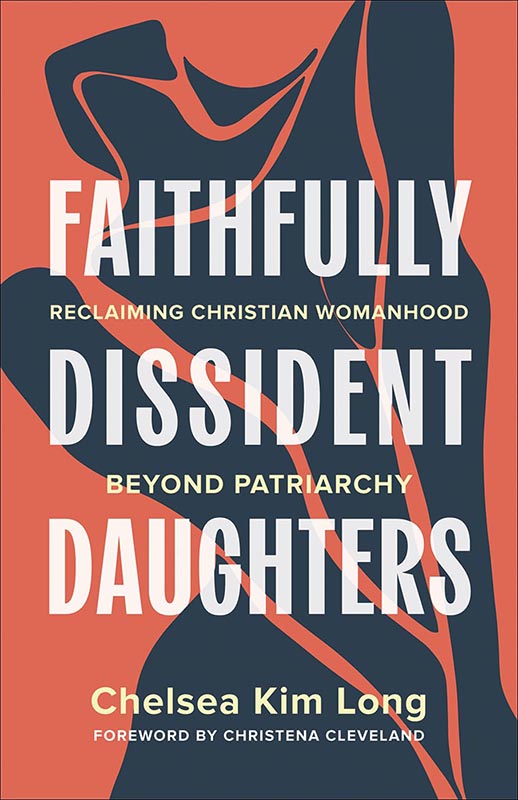
By Chelsea Kim Long
Westminster John Knox Press: 2026.
Paperback, 212 pages
Reviewed by Halley Kim
 As I was prepped for my C-section, paralyzed on that skinny operating table, arms perpendicular to my body, I realized I was in the crucifix position, waiting to be pierced. I carried birth trauma and was vividly aware of the liminal space between birth and death. There was comfort in Jesus’ solidarity with my ordeal; in dying, he birthed the Church, and with the possibility of mortality hovering in the air, I birthed a child.
But when I later wrote the story into my sermon, my male boss told me I couldn’t claim to know what Christ went through. I felt ashamed and confused; I wasn’t trying to say that I knew what it was to be a first-century Jew who was executed by the state. I was saying that I could find myself in the Christian story, and I hoped other women could do that too.
In her amazing debut book, Chelsea Kim Long accomplishes what my sermon did not—and so much more. Long delivers a stirring manifesto that not only invites women to see themselves in the Christian story but also in God Himself Herself.
“When women and people with other marginalized identities see ourselves in God, when we understand that the Divine is not exclusively white, straight, cisgender, or male, everything changes. We start to ask questions. We stop accepting our own oppression as ‘Godʼs design.’ We begin to trust our own voices, our own wisdom, our own callings.”
Long provides a roadmap to guide us away from patriarchy’s distortions of God, our bodies, and our significance. She takes readers on a four-part journey:
- Awakening to patriarchy’s influence
- Breaking from toxic theology
- Liberating oneself to trust their own body, their own power
- Expanding faith in tangible ways
Altogether Long calls this process and posture faithfully dissident, a nod to Sue Monk Kiddʼs feminist classic The Dance of the Dissident Daughter. “To be faithfully dissident” Long explains, “is to remain rooted in the love of God and the way of Christ, while dissenting from distorted expressions of faith that harm, exclude, or diminish human dignity. It is a posture of tension: refusing to abandon faith altogether and refusing to comply with oppressive forms of religion.”
She found her dignity diminished in the experience of becoming a mother. After her traumatic birth and postpartum period, Long found that her evangelical community had nothing to say on the matter, let alone how God might show up in the midst of it. In countless ways, Long, like so many of us, was implicitly taught that God doesn’t do girly things. It’s one thing to intellectually accept that God is Father (and only Father) when you haven’t experienced the rawness of human reproduction. But once you’re filling a diaper with postpartum blood, nursing a piranha every two hours, and trying desperately to relocate your identity, it can be profoundly lonely. Psalm 139 tells us that it is impossible to be outside of God’s presence, but as Long experienced, there is seemingly an exception.
But here’s the sweet truth that has been veiled for far too long, one Long won’t allow to remain hidden any longer: God actually does do all the girly things.
In Scripture, God has a womb, gives birth, and breastfeeds. Long points out that El Shaddai likely doesn’t mean “God Almighty” as it’s translated in the Bible, but “many-breasted God.” Jesus, referring to communion, said, “Take and eat,” but God the Mother embodies the act, as women also do. Many of us learned that Father God is our Creator, but Long points out what pastors usually don’t: mothers accomplish the vast majority of human reproduction. Likewise, we learned that only God could rise from the dead, but Long highlights that our wombs experience death and resurrection on a monthly basis.
We do not have a God who is unfamiliar with the realities of a female existence or a body with a womb—we have a God who bleeds and swells, loses and mourns, births and nourishes, just as we do. This message is the reframing of Hebrews 4:15 that so many need to hear, and Chelsea Kim Long proclaims it with nuance, grace, and passion.
Long has the receipts to support her argument, too. Faithfully Dissident Daughters is replete with Scripture, Hebrew vocabulary, and historical evidence. I knew that ancient peoples considered the kidneys as the seat of the conscience (much like how today we “listen to our hearts” or “trust our guts”), but I learned from Long that this shows up multiple times on the pages of Hebrew Scripture. Psalm 16:7 speaks of our “reins” (kidneys) instructing us! And it makes me want to scream a bit, because the same people who taught me that the Bible was the infallible Word of God also taught me that I should never ever trust my “desperately wicked” body, let alone learn from her.
I also learned from Long that Mary Magdalene may have been synonymous with Lazarus’ sister, Mary of Bethany, and that Martha’s presence in John 11 may have been added to the text later to strip a Christological confession from Mary Magdalene’s mouth, lest she have too much influence. There’s more: Magdalene, Long writes, may not be a reference to Mary’s hometown but rather an Aramaic title: Mary the Tower. A tower of faith. A leader. “What if the leaders of the early church were meant to be Peter the Rock and Mary the Tower?” (Cue all the tears.)
This is my favorite kind of book, one that braids fascinating information with a touching personal story. Long is so generous in sharing her lived experiences, from losing her dear friend to cancer to navigating infertility to the abortion she thought she’d never have. She was raised to believe that abortion was a horrific sin, so when she became pregnant with quadruplets—medically dangerous for her as well as the fetuses—she and her husband opted to reduce the pregnancy to twins. Chelsea kept this to herself for years, fearing the judgment of others.
Many readers will finally be able to breathe after reading this section of Chelsea’s story. As she discusses, her abortion experience blew up her former uncomplicated faith, the one in which things were black and white, right and wrong. When life forces us to awaken to its messy complications, it is often unsafe to open up to those who still slumber under the illusion of tidy principles. We must seek out a faith—a God—that is big enough for the bodies of women, of queer and trans people, of people of color, and of those with disabilities.
None of the feminist theology presented in Faithfully Dissident Daughters is removed from lived experience. Every bit of it was hard-won in the author’s real life, giving Long the credibility and sensitivity needed to meet readers in their own dark places. And as a neighborhood pastor and lay theologian, Long is as accessible as she is brilliant.
If your faith is morphing into something unrecognizable, if it makes your left eye twitch to see women blocked from church leadership, if a reproductive trauma has ever sent you spiraling, if you know that God’s love is incompatible with the theology you were handed but you need that unpacked—do yourself a favor and pick up this book.

Please request written permission before reprinting any part of this review.
© 2026 by Christian Feminism Today