by Rev. Dr. Jann Aldredge-Clanton
This article, Sharing Our Stories, Healing Our Lives, is a transcript of a presentation given at the 2012 Christian Feminism Today Gathering, Saturday, June 22. Editing was minimal. Scroll to the bottom of the page (or click here) to find a printable pdf version and an audio version of this presentation.

Wherever healing and liberation are happening, stories are being told. We gather here to share our stories. We come to share our stories, to heal our lives.
I begin with the story of my liberation. In 1976 when I was teaching English literature at Dallas Baptist University, my husband David gave me the book, All We’re Meant to Be by Letha Dawson Scanzoni and Nancy A. Hardesty. David hadn’t read the book, or he wouldn’t have given it to me! Well, he says now he’s pretty glad—he’s been adapting to me. But yeah, neither of us could have imagined the revolution that it would have on me.
The words from Amazing Grace, “I was blind, but now I see,” became a reality for me. I’d never before questioned those traditional biblical interpretations that told women we were to be submissive at home and at church. I hadn’t objected to designations of David as head of the house and me as Mrs. David Clanton, and it had never occurred to me to question the divine right of men as church leaders.
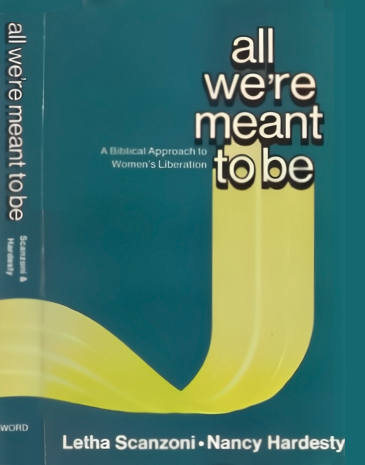 But as I read All We’re Meant to Be, I discovered more than enough biblical support to support equality in the home and in church leadership. And, this book introduced me to the radical notion that God might be more than male. Although Betty Friedan’s The Feminine Mystique had come out in 1963, I’d never heard of the book nor ever raised any questions about traditional roles for women. The call to gender justice could reach me only through the Bible and interpretations of it. With great enthusiasm, I bought additional copies of All We’re Meant to Be and gave them to the men in leadership at our church. It was at Calvary Baptist in Dallas, Texas.
I naively thought that their minds would also be open to the new revelations that I had found— that the copious scriptural evidence and the thorough convincing theological reasoning would convince them like it had convinced me of the truth of gender equality. The chairman of the deacons graciously accepted the book and later told me he found it “interesting.” Well, since I knew him to be a man who tried to please everybody in the church and didn’t want conflict, I shouldn’t have been surprised by his non-committal response. I also gave a copy to the pastor of our church. He never said a word about it to me. His only acknowledgement was telling David to tell me that he had read it. (You know, you talked to a woman through her husband.) I should have known that the pastor of Calvary Baptist wouldn’t have appreciated All We’re Meant to Be because he had made it clear that he didn’t believe women were meant to be that much.

Even though my friend Raynal Barber had a PhD and chaired the English department at Dallas Baptist University, Calvary Baptist allowed her no leadership roles except that of teacher of a women’s Sunday school class. What upset Raynal and me most was the pastor’s practice of inviting only the men and boys to the altar for prayer at the end of services. Raynal steamed, “It’s like he believes all men and even little boys are more spiritual than any woman no matter how saintly or wise she may be.”
Even though All We’re Meant to Be didn’t change the deacon chairman or the pastor of our church, it transformed me. I became an instant convert, an enthusiastic evangelist of the new truths of biblical feminist equality that I had learned.
I began to devour other books on inclusive theology and worship—books like Virginia Ramey Mollenkott’s The Divine Feminine: The Biblical Imagery of God as Female, and that book had a revolutionary effect on me too. I have used it so much in my writing and my preaching and my speaking, so thank you, Virginia, for that book.
And I read Rosemary Radford Ruether’s Sexism and God-Talk; Elisabeth Schüssler Fiorenza’s In Memory of Her; Miriam Therese Winter’s WomanPrayer, WomanSong. I was reading [the magazine] Daughters of Sarah.
All of this was compelling biblical / theological / psychological support not only for gender equality and humanity, but also equality in heaven. … I begin to see how our images of the divine are so foundational to gender equality. I found all this support for biblical female divine names and images. So, I began balancing she with he in references to God. I began to refer to Christ as Christ-Sophia (Sophia is the Greek word for wisdom and connected to Christ), and to do a lot of research on that and then to use other biblical divine feminine metaphors in my writing and my hymn writing. I felt called more and more to incorporate this into my writing and in my speaking and in my ministry.

Another epiphany had come to me a little earlier when I saw gender equality embodied through the ordination of Martha Gilmore at Cliff Temple Baptist church in Dallas, Texas. She was the first Baptist woman to be ordained in Texas, one of the first in the South. For the first time in my life, I saw a woman kneeling before the congregation as a long line of people, women as well as men, passed by to lay hands of blessing on her. Before then, I had seen only men ordain only men. Now, something new was happening. A woman was receiving the sacred blessing, and from somewhere deep within my soul, I knew the rightness of it.
My friend Raynal, who had gone with me to the service, said to me afterwards, “Jann, one day we’ll be going to your ordination.” I said, “Oh, no, no, no, no. I’ll persuade, write. I can write. I look up all this biblical support, I’ll give chapter and verse, but I wouldn’t want all of the criticism and struggle Martha’s gone through.”
Eight years later, Raynal stood at my ordination to read these words of the prophet Habakkuk. “Write the vision, make it plain on tablets so that a runner may read it, for there is still a vision for the appointed time. If it seems to tarry, wait for it. It will surely come.” Martha Gilmore preached the ordination sermon. Proclaiming that I was the vision made flesh, the vision that God indeed calls women to ordained ministry. Martha declared that I had also become a statement, a promise for many women and men and a hope for many women who may be frightened to hear the divine call.
It helped to hear Martha bless me as a statement because that word had been used negatively in reference to me and other women who had followed non-traditional paths. Probably had it referred to you too. People would try to dismiss me by saying, “Oh, you’re just trying to make a statement.” I realized we were at a time in history when statements about the worth of women needed to be made, and these statements still need to be made today as much as ever. These statements still need to be made about the worth of women. That’s the reason for our gathering here tonight and for all the wonderful work of EEWC to affirm the sacred worth of women and all human beings and all creation.
As a minister in various settings, I continued to discover the power of naming—naming of divinity and of humanity.
A new name went with me. When I became a chaplain at Baylor University Medical Center, I was Jann Aldredge hyphen Clanton. I Insisted that this name be inscribed on my chaplain’s badge, in spite of many objections. The department secretary complained that it was too long to get on the badge and as well as on department schedules. My colleagues objected that Chaplain Aldredge-Clanton was too cumbersome to be used around the hospital. Also, they worried that it might be construed as making a feminist statement and get them as well as me in trouble.
At first, my husband, David, took it as a personal affront. “What’s wrong with Clanton? Why do you need to change your name after all these years?”
“Well, I want to keep my Aldredge identity and that Aldredge keeps getting dropped if I don’t hyphenate it. How would you feel if you changed your name?”
The zealous opposition to the hyphen in my last name, just like [the opposition to] calling God She, convinced me of its importance. I recalled responses I’d gotten to requests I’d made to balance She and He in references to deity. “Oh, you’re just making a big deal over a few words, the creator of the universe can’t be limited. He’s above male or female.” When I agreed and said there should then be no more problem referring to God as She than as He, I got strong negative reactions. No better proof could be found for the bias against the feminine and the need to overcome it by calling God “She.”
My hyphenated last name also carried power more than I first realized, power to confront traditional discrimination against women. My colleagues were right, it was a feminist statement, and I was proud of it.
Years before a woman at an English teacher’s conference had asked me when I introduced myself, “Is that your husband’s name or your father’s?” I stared at her as she laughed and said, “I didn’t take my husband’s name because I reject that symbolism. But then I realized I still had my dad’s name. How can we ever get away from being owned by men?”
Ann Ashworth, my major professor at Texas Christian University, tried to escape by changing from her husband’s name to her father’s name and then to her mother’s maiden name. Now she has her grandfather’s name.
As I was getting used to my new name, Jann Aldredge-Clanton, which I had to admit was a mouthful, I recognized the irony. In trying to reassert my own identity, I now had the names of both my husband and my father, but somehow, at least in my mind, the hyphen made the name my own. My father wasn’t Aldredge-Clanton, and David didn’t change his name.
By telling my story in groups such as this, and by writing my story, I continue to find liberation in healing. Sharing Our Stories, Healing Our Lives.
The introduction to a book of stories by women in an ovarian cance r support group I had facilitated includes these words by Becky Teter, editor of the book and member of the support group:
Once upon a time, she would begin and then you’d hear a story. These stories were about magical creatures, kings and queens and castles. They had happy endings. As you grew up, the stories changed. Instead of being about made-up people in places, they began to be real. They began to be about you. You became a character, and the story became your life. It was about your adventures, challenges, circumstances, important people and places.1
Somewhere along the way, we stopped telling stories. Remembering and reliving experiences may have become painful.
All too often there were no happy endings. It may have become safer not to open up, not to invite others into the story of our lives, but there is healing power in stories, in telling them and in hearing them.
Faye’s story in the book begins:
Who are these women? I asked myself this question as I tried to sit down quickly and calmly in the room. I could hardly believe that was so many women, since I’d expected only a handful would be part of an ovarian cancer support group. I was a deer in headlights. I’d only been diagnosed with ovarian cancer for less than a month.
My mother thought that a group meeting would be swell for me. I went simply because it’s easier to say yes to my mother than no.
There I sat in the group scared, overwhelmed, not wanting to talk one syllable for fear of crying and not stopping, but cry I did. I decided that this meeting would be my last. I would proceed with my chemo treatments with the wonderful support of my partner, Kathy, and my family and friends.
After finishing the challenging chemo treatments, my doctor pronounced me all clear of cancer. I felt relieved, but also haunted by the fear of recurrence. So, I walked back into the support group.
I could not believe I was going to tell these courageous women, many of whom were still in treatment, that I was anxious and afraid when I was no longer receiving chemo. I was sure someone would tell me to snap out of it, but my story was instead, greeted with knowing nods, warm eyes and stories from others who concurred that indeed, the time right after treatment was often the hardest. I was not alone.2
Wisely spoken words can heal. Sharing our stories, healing our lives.
In the novel and movie, The Help, Abilene Clark says, “No one had ever asked what it feels like to be me. Once I told the truth about that, I felt free.” Abilene had told her story, as you remember to Skeeter Phelan for her book. In persuading her friend, Minny Jackson to also tell her story to Skeeter for the book, Abilene allayed Minny’s fears by saying, “We’re not doing civil rights. We’re just telling our stories.” Of course, it became clear that their stories were as powerful or more powerful than direct civil rights action. Their stories were liberating themselves and others,
Sharing our stories, healing and liberating our lives and our world.
Sue Monk Kidd says, “I learned not only how to write stories, but to love them, to revere them even. Humans, I discovered, need stories the way we need air.”
Another southern novelist, Dorothy Allison says, “Stories are the one sure way I know to touch the heart and change the world.”
Matthew Fox, in his book, The Coming of the Cosmic Christ says, “Mystics must come out of the closets, must gather to share our stories that we might set afire again to our tired and cold civilization. These stories can inspire us to acts of prophecy, which can awaken our hearts and renew our culture.”
Also, believing in the power of stories, I decided to use stories rather than statistics or analysis in a book about the connection between social justice and inclusion of the divine feminine in church.

Dr. Rebecca Kiser, who’s pastor of First Presbyterian Church in West Plains, Missouri, is one of the ministers featured in the book Changing Church: Stories of Liberating Ministers.
Becky’s story in Changing Church includes her healing process from the traumatic loss of a child. In an article that was published in an EEWC newsletter, Becky tells the story of the transformation of her divine images that took place after Emma’s death. “As I began sorting out and dealing with my anger and grief, two images of God in the feminine arose in my prayer and became agents of healing and restoration. This was surprising to me because at the time, I was not comfortable using feminine pronouns or imaging God in the feminine.”
One of these divine feminine images Becky calls “God of the Casserole,” and this is the title of the EEWC newsletter article. Becky writes:
I talked of seeing God and the people who came to be with us, bringing dinners and fruit baskets and desserts, as well as their love and care. Yet, I had difficulty accepting this image of God or feeling any comfort from it. …
Suddenly, I remember that old picture from my Sunday school days, where Jesus is standing at the heart’s door and knocking—only when I pictured it now, Jesus was carrying a covered casserole.
Again, I laughed with an edge of anger, what do I do with the God-bearing casseroles?
All the same, the image captured me and wouldn’t go away, so I decided to sculpt it and see what happened. The form that emerged from under my hands was a woman. Like so many of the people who had come to my door, she carried a 9×13 pan of either lasagna or chicken and rice; I couldn’t decide.
She became a focal point of all my ambivalent feelings, for I felt gratitude and comfort from her presence, at the same time that I experienced raging anger, that she didn’t do more, that She wasn’t more powerful. I raged at her again and again, and still she stayed, her face concerned, her gift in her hand. She was not put off by my anger, she didn’t take her gifts and go home. …
I came finally to realize that she is who she is, and the anger was mine, the expectations were mine, the desires for protection and security were mine, the disappointment that came from a false image of God was mine. She is who she has always been: compassionate, strong, present, passionate, truth, connected from the womb, unafraid, encompassing, mysterious. …
Encountering God this way has made me reevaluate the notion of God as beyond gender and see God as encompassing all genders—gender-full rather than genderless. …
I look on the growth of spirit and creativity I’ve experienced as gifts from my daughter Emma and think it is somehow appropriate that it was she who, through her brief time on earth, introduced me to the Great Mother in God.2

Another minister featured in Changing Church who has also written for the EEWC newsletter and has also served on the EEWC Council is Judith Liro, priest of St. Hildegard’s. St. Hildegard’s is in Austin, Texas. Another Texan, I’m glad to say, and it’s a wonderful feminist worship community in the Episcopal tradition. In her story, Judith also tells about discovering the creative healing power of the divine feminine and of the power of sharing the stories of how St. Hildegard’s has met the challenges of being a feminist Episcopal Eucharistic community transforming liturgy. Commitment to inclusive language proved to be the most challenging for St. Hildegard’s community in relationship to the institutional church.
In the EEWC newsletter article, Judith writes:
In the years leading up to the birth of our community, we had become more convinced that the dominance of male imagery in the language of the liturgy was undermining the possibilities for women to experience ourselves as beloved, gifted and responsible beings. With the sacred feminine devalued, the shadow side of the masculine supported violence and dehumanization. What sense did it make for some of us to counsel women who were survivors of domestic abuse and rape and fail to see the church’s role in weaving the subtle underpinnings of this culture? How could those of us who work to prevent war or heal its wounded fail to see the way words in our worship unconsciously played a supporting role in its justification?
St. Hildegard’s longed to be a place where the wholeness of God and humanity could be experienced as much as possible. When we chose to be a Eucharistic community, we entered into a carefully-guarded domain—the sacred core identity of the Anglican tradition. In order to incarnate these transforming changes, we had to find a way to compromise with integrity. I believe that Sophia showed us the way…3
As Judith continued to advocate for inclusive liturgy to support healing and justice and peace, she used a powerful metaphor.
Several factories are built on a river and pollute the water of a village downstream. A hospital is built to treat the illnesses that result, but there is still a need to track down the source of the pollution and to clean up the water itself. Many organizations, including the church, do the important work of the hospital. Yet, I have also come to realize the church is one of the factories that contribute to the problem.
Our liturgical language with its current heavily masculine content supports a patriarchal hierarchical ordering. Most are simply unaware of the power of language. The status quo that includes the exploitation of the earth, poverty, racism, sexism, heterosexism, militarism is held in place by deep symbolic imbalance, and we are unwitting participants in it. 4
Judith has experienced many challenges that you’ll read in her story as she continued this commitment to change the liturgy and to recreate the church, not only the Episcopal Church, but the church in general, through including the divine feminine. At an especially difficult time in her ministry, Judith found the healing, renewing power of stories. She shared her stories to other women. At a retreat center, Judith says, “I was immersed in the strength of women who had prophetic ministries. All this encouragement was like the spirit blowing the breath back into me.” So Judith said, she felt renewed power to continue fulfilling her call to lead Hildegard’s to guards, to recreate the church by transforming the liturgy.
Wisely spoken words can heal and liberate and transform. Sharing our stories, we are healing and liberating and transforming our lives and our world.
Notes
1 Teter, Becky, et al. TORCH: Tales of Remarkable Courage and Hope. Dallas, Texas: Baylor University Medical Center, 2007.
2 Ibid.
3 Kiser-Lowrance, Rebecca. “God of the Casserole,” Update: Newsletter of the Evangelical & Ecumenical Women’s Caucus, Summer 1995, 1.
4 Liro, Judith. “Community, Creativity, Contemplation, and Call as a Feminist Spiritual Path,” EEWC Update, Spring 2005, 12.
5 Aldredge-Clanton, Jann. Changing Church: Stories of Liberating Ministers. Eugene, Oregon: Wipf and Stock, 2011.
© 2012 by Jann Aldredge-Clanton and EEWC-Christian Feminism Today
Please contact us for permission before reprinting any portion of this article.

Listen to the recording of this presentation (Christian Feminism Today podcast #103).
 In honor of CFT’s 50th anniversary, CFT is publishing some important historical reflections, articles, reviews, and other pieces. See more from this series here.